What Is Included in the 11+ Exam? Maths, Verbal & Non-Verbal Reasoning Explained
If you’re beginning to look into the 11+ for your child, one of your first questions will probably be:
What is actually in the exam?
The answer depends on the school and assessment provider your child is applying to.
For families in Chester and the Wirral considering one of the four non-faith Wirral grammar schools, the current assessment is provided by Quest Assessments.
For September 2027 entry, Wirral Council confirms that children take two papers on the same day, covering:
- Verbal Reasoning
- Non-Verbal Reasoning
- Mathematics
The papers are timed and use multiple-choice questions.
Here’s what each of those areas actually means.
What is Verbal Reasoning?
Verbal Reasoning tests a child’s ability to understand, analyse and work with written information.
Rather than simply testing whether a child can spell or write well, verbal reasoning requires them to identify relationships and patterns within language.
Questions might involve skills such as:
- Identifying relationships between words
- Understanding synonyms and antonyms
- Recognising patterns
- Applying logic to written information
- Completing word sequences
- Understanding vocabulary
- Following written instructions accurately
Children with a broad vocabulary often have an advantage because unfamiliar words can make otherwise straightforward reasoning questions considerably more difficult.
This is one reason we encourage families to build vocabulary gradually rather than leaving it until Year 5.
Why is vocabulary so important?
Vocabulary isn’t something that can easily be crammed in the weeks before an assessment.
Children need repeated exposure to words in order to understand them confidently and recognise how they are used.
At OwlPath, vocabulary development forms part of our wider 11+ preparation.
Our Vocabulary Mastery programme can also be used alongside tutoring.
It contains more than 500 words from the Quest Assessments vocabulary list, with children completing short daily missions and revisiting words they have previously found difficult.
This means vocabulary can develop little and often between weekly tutoring sessions.
What is Non-Verbal Reasoning?
Non-Verbal Reasoning tests a child’s ability to recognise patterns and relationships using visual information rather than words.
Children might need to identify:
- Which shape comes next in a sequence
- How a shape has changed
- Which image doesn’t belong
- Relationships between shapes
- Rotations and reflections
- Visual patterns or rules
These types of questions can initially feel very unfamiliar.
The good news is that children can learn strategies for approaching them.
Rather than simply guessing what “looks right”, students can be taught to systematically look for changes involving:
- Shape
- Position
- Number
- Rotation
- Direction
- Shading
- Size
Once children know what they are looking for, seemingly complicated questions often become much more manageable.
What Maths is included in the 11+?
11+ Maths is not simply about being able to complete calculations quickly.
Children need strong mathematical foundations, but they also need to be able to apply their knowledge to unfamiliar problems.
Preparation may involve areas such as:
- Addition, subtraction, multiplication and division
- Fractions, decimals and percentages
- Measurement
- Time
- Money
- Geometry
- Number patterns
- Problem solving
- Multi-step questions
As children move closer to the assessment, they also need to become comfortable choosing an efficient method under timed conditions.
A student might know exactly how to solve a problem but still lose marks if each question takes too long.
Where does English fit in?
Parents sometimes ask why OwlPath assesses English when the current Wirral assessment areas are described as Verbal Reasoning, Non-Verbal Reasoning and Mathematics.
That’s because strong English skills underpin a significant amount of 11+ learning.
Reading comprehension and vocabulary can affect how confidently children understand questions, interpret written information and tackle verbal reasoning.
Some independent school entrance assessments also have different structures and may include more explicit English components.
OwlPath tutors have experience working with Quest, GL Assessment, CEM and ISEB-style assessments, so preparation can be adapted to the schools a child is considering.
Do children need to practise all three subjects equally?
Not necessarily.
This is one of the reasons we don’t recommend starting an 11+ programme by simply buying three workbooks and completing the same amount from each.
Every child has different strengths.
For example:
Child A may be working significantly above their age in Maths but have a relatively limited vocabulary.
Child B may be an excellent reader but find Non-Verbal Reasoning completely unfamiliar.
Child C might understand all three areas but work too slowly when timed.
Those children shouldn’t receive identical preparation.
How does OwlPath identify what a child needs?
Every new OwlPath 11+ student begins with a free 30-minute diagnostic assessment.
We assess:
- English
- Maths
- Verbal Reasoning
- Non-Verbal Reasoning
Parents receive a score out of 10 for each area, alongside a more detailed breakdown of individual skills.
We then create a personalised study roadmap.
After the assessment, parents have a free consultation with their child’s tutor to discuss the results and decide on the appropriate programme, format and areas of focus.
Building towards exam conditions
Learning the content comes first.
But eventually, children also need to be able to apply those skills under examination conditions.
That means gradually introducing:
- Timed questions
- Time management
- Multiple-choice strategies
- Answer-sheet familiarity
- Working through difficult questions without becoming stuck
- Mock examinations
For the current Wirral test, official familiarisation material confirms that children work through timed multiple-choice papers and record responses on a separate answer sheet.
Becoming familiar with that process before exam day means the format itself doesn’t have to be completely new.
Preparing for the 11+ in Chester and the Wirral
OwlPath provides 11+ tutoring for children in Years 3, 4 and 5 across Chester and the Wirral.
Rather than starting with a generic programme, we begin by finding out exactly where your child is now.
Book a free OwlPath 11+ Diagnostic Assessment to discover your child’s strengths, gaps and recommended next steps.
More From OwlPath
11+ Tutoring in Chester: What Should Parents Look For?
If you’re searching for 11+ tutoring in Chester, you will quickly discover that there are plenty of options. One-to-one tutors. Large tuition centres. Online co…
Read more →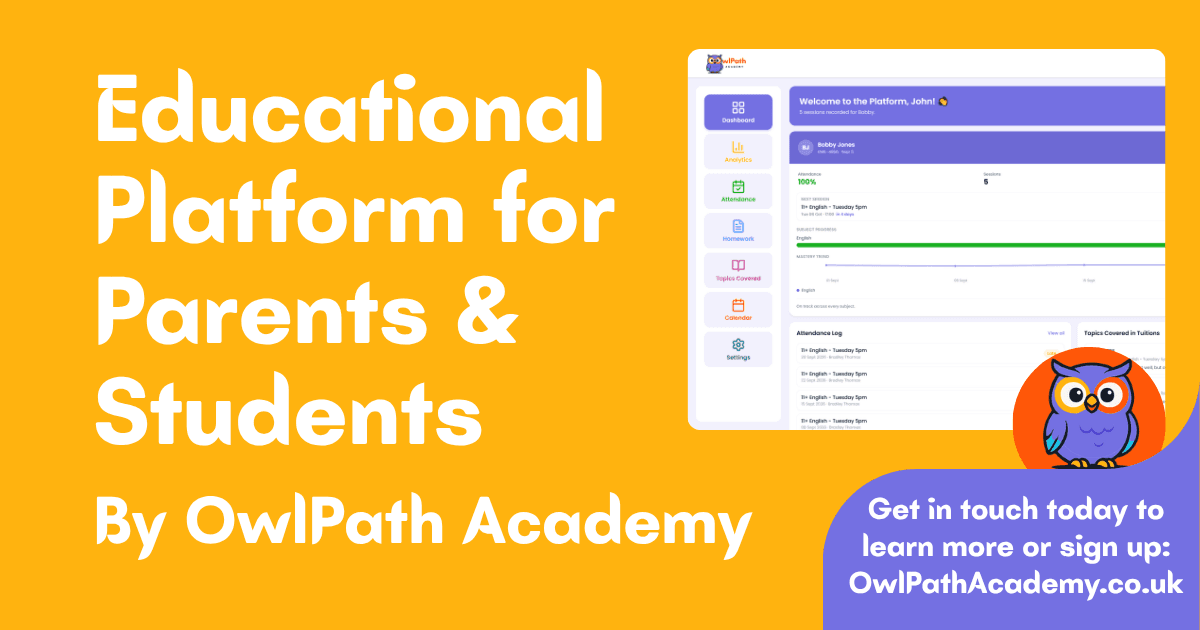
OwlPath Academy Educational Platform for Parents & Students
See attendance, topics covered, progress and homework after every lesson. How OwlPath Academy’s educational platform works for parents and students.
Read more →
How Does the Wirral 11+ Work? A Guide for Parents
If your child is considering a grammar school on the Wirral, the 11+ process can initially seem confusing. There are assessment registrations, school applicatio…
Read more →Not Sure Where to Start?
Take a free 11+ baseline assessment to see exactly where your child stands, or book a free consultation to talk it through.

